

Why Multi Destination Trips Are Worth the Effort
A multi destination trip allows you to visit multiple cities or countries in one journey, typically booked on a single ticket or coordinated itinerary. Here’s what you need to know:
Key Types:
- Extended layovers – Turn long connections into mini city tours
- Open-jaw flights – Fly into one city, depart from another
- Multi-city itineraries – Visit 3+ destinations in sequence
Main Benefits:
- Cost savings – Up to 50% cheaper than separate one-way tickets
- Time efficiency – See more places in less vacation time
- Seamless planning – One booking handles multiple destinations
Planning Essentials:
- Choose logical routes to minimize backtracking
- Use flight comparison tools with multi-city search functions
- Allow buffer time between destinations for delays
As one traveler noted: “A holiday is always nice – but a multi-destination trip is a true trip.”
The challenge? Planning multiple destinations can feel overwhelming. Between comparing flight routes, coordinating hotels, and managing logistics across different time zones, many travelers abandon their multi-city dreams before they start.
But here’s the thing – with the right approach, planning a multi destination trip doesn’t have to drive you crazy. The key is breaking it down into manageable steps and using smart tools to handle the complexity.
I’m Michael Melichar, Co-Founder of Triptimize, where I’ve helped thousands of travelers plan seamless multi destination trip experiences without the usual headaches. My background in product strategy and travel tech has shown me exactly where multi-city planning goes wrong – and how to fix it.
Mastering the Multi Destination Trip Basics
Think of a multi destination trip like connecting the dots on a map – but instead of drawing lines, you’re creating memories across multiple cities and countries. Before we dive into the nitty-gritty of planning, let’s make sure we’re all speaking the same language.
What Exactly Is a Multi Destination Trip?
A multi destination trip is your ticket to experiencing three or more cities or destinations in one epic journey. Unlike hopping on a simple round-trip flight to Paris and back, you’re essentially becoming the architect of your own travel trip.
Here’s where it gets interesting: you have options. You can book everything on one ticket through airlines that offer multi-city flexibility. As Air Transat puts it, you can “land in one city and leave from another city, or even country, at no extra charge.” Pretty sweet deal, right?
But the real magic happens when you start combining different transport modes. Picture this: you fly into Rome, take a scenic train to Florence, catch a ferry to Greece, then fly home from Athens. Each leg becomes part of the trip, not just a way to get from point A to point B.
Now, here’s a game-changer many travelers miss: creating stopovers. This is where understanding the difference between layovers and stopovers becomes your secret weapon.
Layovers are those quick connection periods – usually under 24 hours. Think 30 minutes to 4 hours for domestic flights, or 1 to 24 hours for international connections. You’re basically stuck in the airport.
Stopovers, on the other hand, are where the magic happens. These are planned stops over 24 hours that can extend up to 10 days on some tickets. That 3-day stopover in Dubai on your way to Thailand? That’s essentially a free extra destination added to your trip.
Benefits of a Multi Destination Trip Itinerary
Let’s talk numbers – because multi destination trips deliver some pretty impressive advantages that’ll make your wallet and your wanderlust equally happy.
Cost savings are often the biggest surprise. Multi-city flight bookings can slash your travel costs by up to 50% compared to booking separate one-way tickets for each destination. We’ve watched travelers save hundreds of dollars per person just by being strategic about their booking approach.
Time efficiency is another game-changer. Why burn three separate weeks of vacation time visiting European capitals when you can experience the highlights of multiple countries in one incredible journey? You’re maximizing those precious vacation days while minimizing the jet lag recovery periods that come with multiple international trips.
There’s something special about deeper cultural exploration when you’re connecting destinations. Instead of surface-level tourism, you start seeing the threads that connect different cultures. That train ride from Prague to Vienna isn’t just transportation – it’s a journey through changing landscapes, architecture, and history.
Reduced travel stress might be the most underrated benefit. When you book all flights at once through a multi-city itinerary, you’re dealing with fewer confirmation emails, fewer booking references, and often better protection if something goes wrong. Plus, there’s something satisfying about having your entire trip mapped out in one cohesive plan.
The flexibility factor is huge too. Multi-city tickets often come with more generous change policies than rock-bottom one-way fares. When your plans inevitably shift (because they always do), you’ll be glad you have options.
Step-by-Step Planning Blueprint
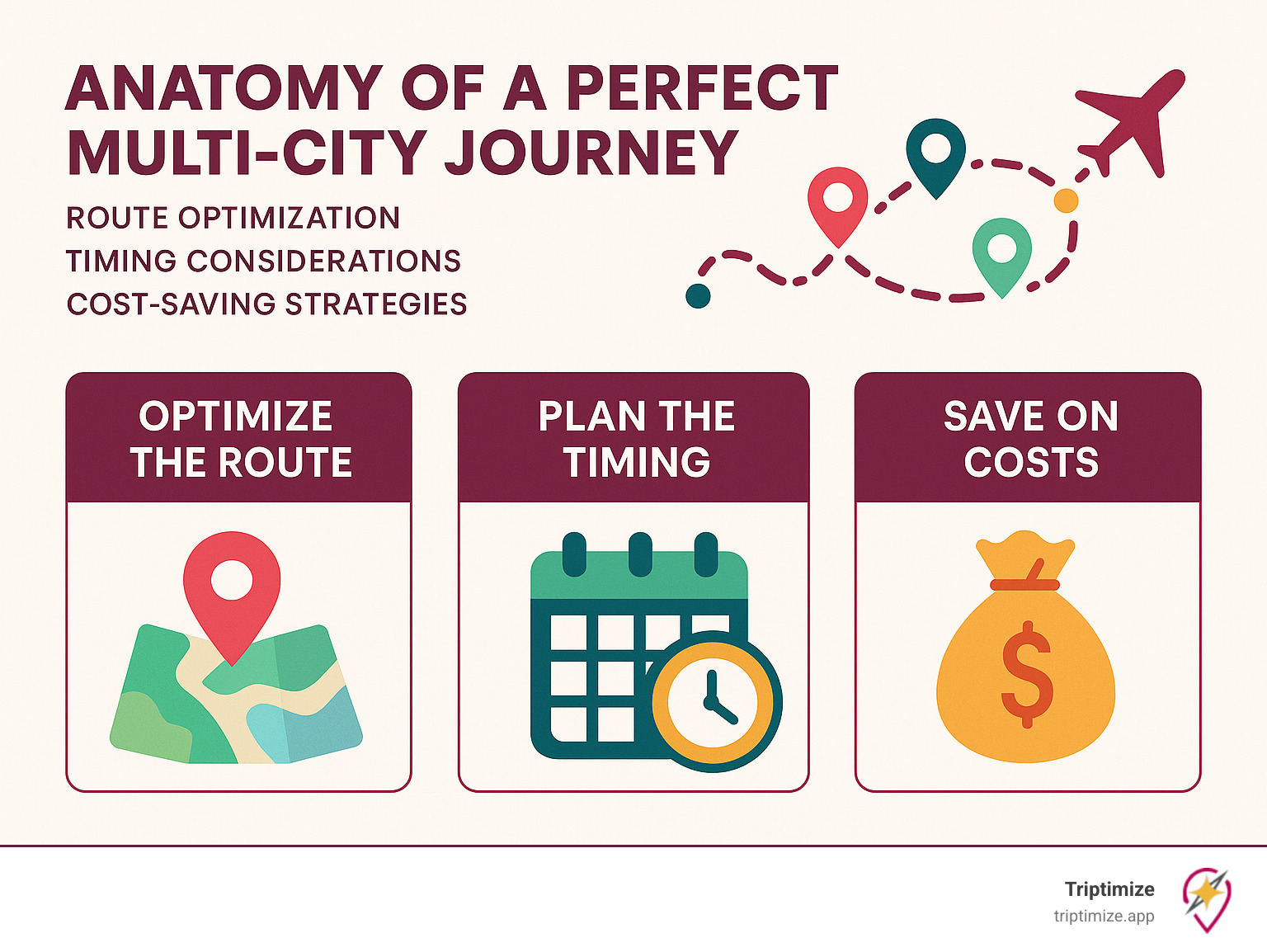
Planning a multi destination trip might seem daunting, but it’s actually quite manageable when you break it down into logical steps. Think of it like assembling a puzzle – once you understand the pieces, everything clicks into place.
The first decision you’ll face is choosing your booking strategy. Here’s how the main options stack up:
| Booking Type | Best For | Average Cost | Flexibility | Complexity |
|---|---|---|---|---|
| Round-trip | Simple vacations | Lowest | Low | Easy |
| One-way | Open-ended travel | Highest | High | Medium |
| Multi-city | 3+ destinations | Medium | Medium | High |
Multi-city bookings hit the sweet spot – you’re not paying those brutal one-way fares, but you’re also not stuck with a boring there-and-back itinerary. It’s the Goldilocks of travel booking: just right.
The secret sauce? Start with logistics, then add the fun stuff. I know it’s tempting to plan around that amazing restaurant in Bangkok or that Instagram-worthy sunset in Santorini, but getting your route right first will save you hundreds of dollars and countless headaches.
More info about our process shows how we handle all these complexities automatically, but understanding the basics helps you make smarter decisions.
Craft Your Multi Destination Trip Route
Geography should be your best friend when planning any multi destination trip. That dream itinerary jumping from Tokyo to Paris to New York? It might sound exciting, but your wallet (and your sanity) will thank you for thinking more strategically.
The hub strategy is your secret weapon. Major airline hubs like London, Dubai, or Singapore exist because they naturally connect multiple regions. Building your route around these hubs often open ups better pricing and more convenient schedules. It’s like having a travel cheat code.
European train corridors are pure magic for multi-city trips. Routes like London-Paris-Brussels-Amsterdam or Rome-Florence-Venice-Milan are practically designed for this type of travel. The trains are comfortable, the stations are city-center, and you’ll see countryside that flights completely miss.
Before you get too excited about any route, try the Google Maps test. Plot your destinations and see if you’re zigzagging across continents like a pinball. If the route looks crazy on a map, it probably is.
Regional clustering consistently works best. Western Europe flows beautifully from London to Paris to Rome to Barcelona. Southeast Asia connects seamlessly from Bangkok to Chiang Mai to Phuket. The US West Coast practically begs for a Vancouver to Portland to San Francisco to San Diego trip.
The key is thinking like water – follow the path of least resistance. Your future self will thank you when you’re not dealing with 14-hour layovers in random airports.
More info about Custom Travel Experiences – our AI considers all these geographic factors automatically when building your itinerary, so you don’t have to become a geography expert overnight.
Optimizing Costs on a Multi Destination Trip
This is where smart planning transforms an expensive dream into an affordable reality. The difference between a budget-busting trip and a reasonable one often comes down to a few key strategies.
Flight search tools are your best friend for multi-city bookings. Look for platforms that let you search multiple destinations at once – some allow up to six legs in a single booking. The “flexible airport” feature can uncover hidden deals in nearby cities that you might never have considered.
Flexible dates are pure gold. Being willing to shift your travel dates by even 2-3 days can save hundreds of dollars. Airlines’ price calendars show you exactly which days are cheapest – it’s like having x-ray vision for flight deals.
Credit card points multiply quickly on multi-city trips. Travel rewards cards that give double or triple points on travel purchases can add up to free flights or hotel nights. When you’re booking multiple flights and hotels, those points accumulate fast.
The 60-day booking rule consistently delivers savings. Many airlines and tour operators offer significant discounts when you book at least two months ahead. We’ve seen savings of $500 or more per couple just from planning ahead.
Mixing airlines strategically can slash costs. Use budget carriers for short European hops, then switch to major airlines for your transatlantic legs. Many booking platforms now let you combine different airlines seamlessly.
The hidden city strategy exists, but tread carefully. Some travelers use intermediate stops as their actual destination, but airlines aren’t fans of this practice. Know the risks before you try it.
Latest research on route planning consistently shows that advance planning and flexible thinking yield the best prices and availability. The travelers who save the most money are usually the ones who plan the smartest, not necessarily the earliest.
Packing & On-the-Road Logistics
Here’s the reality: multi destination trips challenge everything you know about packing. You’re not just planning for one climate or one culture – you’re preparing for multiple environments while keeping your luggage manageable.
The secret isn’t packing for every possible scenario; it’s packing smart and staying organized while you’re constantly on the move.
Smart Packing for Multiple Climates
Think of yourself as a travel minimalist, not a walking department store. The goal is to layer strategically rather than pack for every weather possibility.
Climate clustering is your best friend. If you’re touring summer Europe (London → Paris → Rome), you’re dealing with similar weather patterns. But mixing Iceland and Morocco in the same trip? That’s when packing becomes a real challenge.
Compression cubes transform everything. They’re not just space-savers – they create an organization system that keeps you sane. One cube for warm-weather essentials, another for cold-weather gear, and a third for all those cables and electronics that somehow multiply during travel.
The age-old roll versus fold debate has a clear winner for multi-city travel: rolling saves about 30% more space and reduces wrinkles. Save folding for structured items like blazers or dress shirts that actually need the crisp edges.
Strategic laundry stops are game-changers. That 4-day stay in Barcelona? Perfect timing to refresh your entire wardrobe mid-trip. Plan these longer stops as your laundry days, and suddenly you can pack half as much.
Your multi-climate essentials should work overtime: merino wool base layers that keep you warm when it’s cold and cool when it’s hot, a packable down jacket that stuffs into a tiny pouch, quick-dry travel pants that work for both sightseeing and nice dinners, plus the obvious universal power adapter and portable phone charger.
Staying Organized While You’re Moving
Organization becomes absolutely critical when you’re juggling multiple bookings, time zones, and transportation modes. Lose track of one confirmation, and your entire itinerary can solve.

Go digital-first with everything. Paper tickets get lost in the shuffle between cities. Digital confirmations stored in your phone’s wallet app stay with you. Screenshot every important confirmation and store it offline – you’ll thank yourself when you’re standing in a train station with spotty internet.
Itinerary apps become essential tools beyond basic booking confirmations. You need something that aggregates all your travel information and provides real-time updates. When your flight from Prague gets delayed, you want to know immediately how it affects your connection to Vienna.
Download offline maps for each destination before you arrive. Data roaming charges add up quickly across multiple countries, and being lost in an unfamiliar city with no internet connection is nobody’s idea of fun.
The 24/7 support advantage becomes crucial for complex multi-city itineraries. When things go wrong – and they sometimes do – having access to assistance around the clock can save your entire trip. Flight delays in one city can cascade through your entire itinerary, and you need someone who can help you steer the rebooking process.
More info about Use Cases shows how other travelers have successfully managed complex multi-city logistics without losing their minds in the process.
Common Pitfalls and Pro Tips
Let’s be honest – multi destination trips can go sideways fast. After helping thousands of travelers steer complex itineraries, we’ve seen every possible mistake. The good news? Most disasters are totally preventable with the right approach.

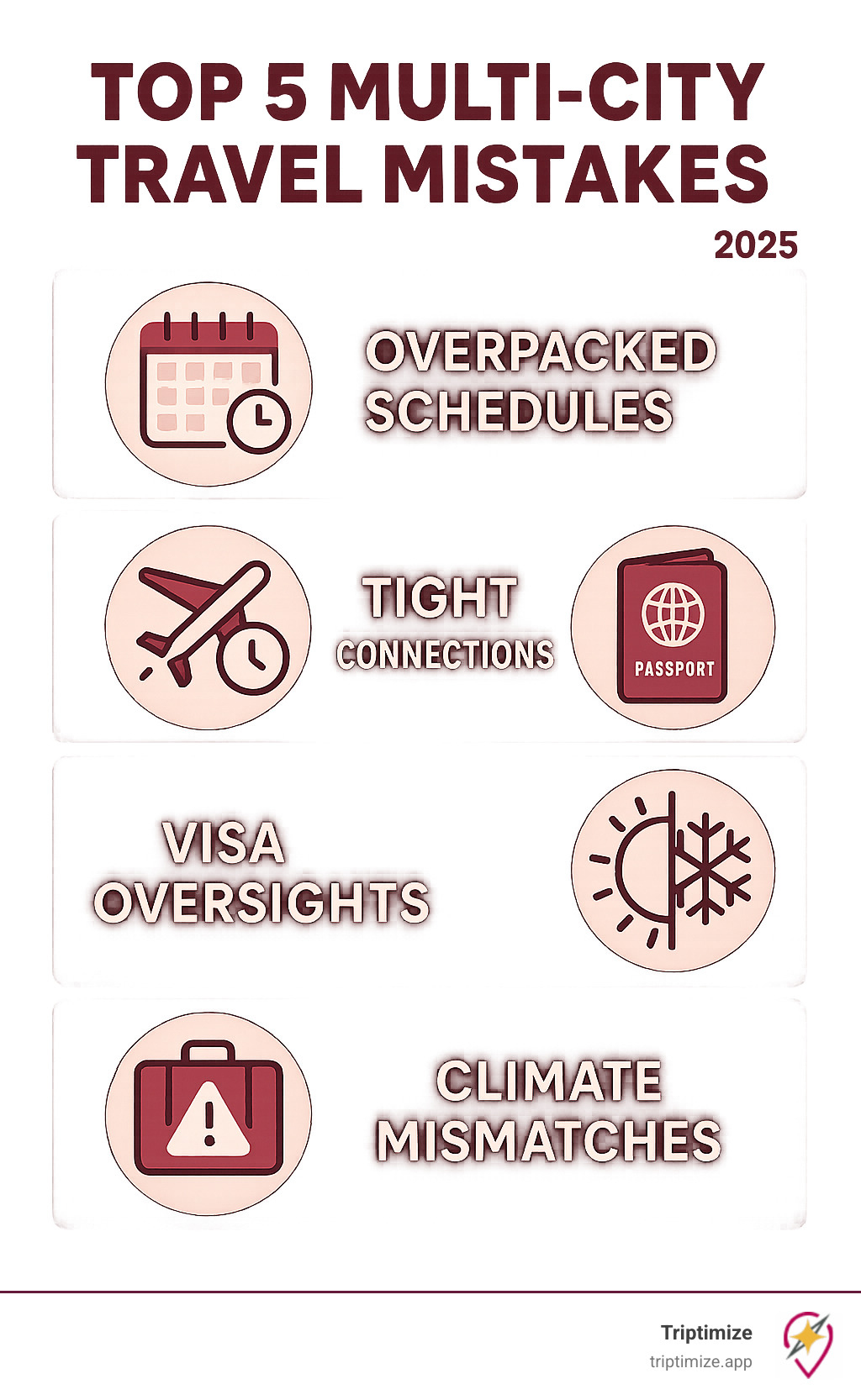
The biggest trap? Overstuffed schedules. We get it – you want to see everything. But cramming five cities into seven days isn’t a vacation, it’s a marathon. You’ll spend more time in airports than actually exploring.
Tight connections are another recipe for disaster. That 45-minute connection in Frankfurt might look doable on paper, but when your first flight is delayed and you’re sprinting through terminals with luggage, you’ll wish you’d booked that longer layover.
Then there’s the visa surprise. Nothing ruins a trip faster than finding you need a visa for your “quick stopover” in Mumbai. Some countries require transit visas even if you’re not leaving the airport. Research every single country you’ll touch down in, not just your main destinations.
Climate mismatches catch people off guard too. Packing for London’s drizzle and Morocco’s desert heat in the same suitcase? That’s where smart layering strategies become essential.
Turning Layovers into Free Mini-Trips
Here’s where multi-city travel gets genuinely exciting. That dreaded 8-hour layover in Amsterdam? It’s actually a gift in disguise.
Airport city tours are more common than you’d think. Singapore’s Changi Airport runs free tours for passengers with layovers over 5.5 hours. Dubai offers similar programs. You’re literally getting a free destination added to your trip.
Luggage storage at major airports makes city exploration possible. Most international hubs have secure storage facilities where you can drop your bags for a few hours. Suddenly you’re wandering through Amsterdam’s canals or sampling street food in Bangkok with just a daypack.
Hotel day rooms near airports offer another smart option. Need a shower and a nap during that 10-hour layover? Day-use rooms cost less than overnight stays and let you arrive at your next destination refreshed instead of exhausted.
The 6-hour rule is your friend here. For international layovers, you generally need at least 6 hours to clear immigration, explore the city, and return with comfortable buffer time. Less than that, and you’re rushing more than relaxing.
Building Flex Days for the Unexpected
Buffer days aren’t luxury – they’re necessity. Build one flex day into every week of travel. Weather delays happen. Strikes shut down transportation. Sometimes you just fall in love with a city and want to stay longer.
Monday morning flights are particularly risky. Weekend disruptions have a nasty habit of cascading into Monday schedules. If you must fly Monday, give yourself extra buffer time from your previous destination.
Travel insurance becomes more complex with multiple destinations. Standard policies might not cover trip interruption across all your planned stops. Make sure your coverage matches your itinerary’s complexity.
Strike season awareness can save your trip. European strikes follow predictable patterns – French air traffic control strikes peak in summer, German rail strikes are more common in winter. A little research goes a long way.
The reality is that weather delays will happen. Strike risks are real. Tight connections will occasionally fail. Building flexibility into your multi destination trip isn’t pessimistic – it’s smart planning that lets you handle problems without panic.
More inspiration in our Gallery – see how other travelers have handled unexpected situations and turned potential disasters into memorable trips.
Frequently Asked Questions about Multi Destination Trips
Planning a multi destination trip brings up some common questions. Here are the three we hear most often – with straight answers that’ll help you book with confidence.
How do I compare costs quickly?
The fastest way is using multi-city search tools that show your total trip cost upfront. This gives you the real number – no surprises hiding in separate bookings.
Here’s the comparison trick: Search your route as one multi-city booking, then compare it against booking each flight separately. In most cases, the multi-city option saves you 20-50% compared to separate one-way tickets, especially when you book in advance.
But don’t just look at the dollar amount. Factor in the convenience value too. One booking confirmation instead of five. One customer service number if things go wrong. One set of change fees if you need to adjust dates.
The time you save not juggling multiple bookings? That’s worth something too.
Can I mix airlines and still stay on one ticket?
Yes, but it gets tricky. Some booking platforms let you combine different airlines into one itinerary, but you’ll lose important protections.
Here’s what happens: If your first flight gets delayed and you miss your connection on a different airline, you might be stuck buying a new ticket out of pocket. The airlines don’t talk to each other about your problems.
The safer bet? Stick with airline alliance partners. Star Alliance, OneWorld, or SkyTeam airlines work together when delays happen. They’ll rebook you automatically and handle your bags through the entire journey.
If you do mix airlines, build in extra buffer time between flights. That 90-minute connection becomes a 3-hour minimum when you’re switching carriers.
What’s the difference between a stopover and an open-jaw?
These terms get thrown around a lot, but they’re actually different travel strategies for your multi destination trip.
A stopover is a planned stay of 24+ hours in a connection city. Think flying NYC → London (stay 3 days) → Rome, all on one ticket. You’re using that connection point as an actual destination.
An open-jaw means flying into one city and departing from another. Like flying into London and leaving from Rome, with ground transport connecting them. No backtracking to your arrival city.
The cool part? You can combine both strategies on the same ticket. Fly into London, stopover in Amsterdam for two days, then continue to Rome and fly home from there.
Both options give you maximum flexibility without the cost penalty of separate bookings. Your multi destination trip becomes a seamless journey instead of a collection of separate flights.
Conclusion
You’ve just learned everything you need to turn your multi destination trip dreams into reality. What seemed overwhelming at first – juggling multiple flights, cities, and logistics – is actually quite manageable when you break it down step by step.
The magic happens when you understand your options first. Whether you’re planning stopovers, open-jaw flights, or a full multi-city circuit, knowing the difference helps you choose the right approach. Then comes the fun part: crafting logical routes that don’t have you zigzagging across continents and optimizing costs through smart booking strategies.
Remember the practical stuff too. Pack smart for multiple climates, stay organized with digital tools, and most importantly – build in flexibility. Those buffer days aren’t wasted time; they’re your insurance against the unexpected delays and delightful surprises that make travel memorable.
The rewards make every bit of planning effort worthwhile. You’ll save serious money compared to separate trips, squeeze more trip into your precious vacation days, and create those incredible connected experiences that single-destination trips just can’t match.
Here’s the best part: technology has revolutionized multi-city planning. Gone are the days of juggling spreadsheets and calling travel agents. Real-time updates, integrated booking platforms, and AI-powered optimization handle the complexity while you focus on the excitement.
At Triptimize, we’ve seen thousands of travelers transform their multi-city dreams into seamless reality. Our AI considers everything – routing efficiency, cost optimization, real-time availability across flights, hotels, and experiences – while keeping your itinerary flexible and completely stress-free.
Ready to stop dreaming and start planning? More info about planning your next trip – we’ll handle all the complexity while you focus on choosing which amazing destinations to explore.
The world is absolutely waiting for you. Why settle for visiting one incredible place when you can experience three, four, or even more destinations in one unforgettable journey?