

The Travel Planning Revolution: From Hours to Minutes
What Is an AI Travel Planner and How Does It Really Work?
Picture this: you’re dreaming of your next vacation, but instead of spending hours researching destinations and juggling spreadsheets, you simply tell a smart assistant what you want. Within seconds, you have a complete, personalized itinerary with flights, hotels, and activities all perfectly coordinated.
That’s exactly what an ai travel planner does. It’s like having a travel expert who never sleeps, has visited every corner of the world, and remembers exactly what you love about traveling.
The magic happens through machine learning and natural language processing—fancy terms that basically mean the AI can understand what you’re asking for in plain English and learn from millions of travel experiences to give you the perfect plan.
You might say something like “I want a romantic 5-day trip to Italy with amazing food and historic sites, budget around $3,000.” The AI doesn’t just throw random suggestions at you. It analyzes your request, considers thousands of options, and creates a day-by-day itinerary that actually makes sense for your travel style and budget.
The whole process takes seconds, not hours. No more drowning in browser tabs or trying to coordinate flight times with hotel check-ins on your own.
Learn more about how our system works
The Technology Behind the Magic
Here’s where things get really interesting. Modern AI travel planners are built on sophisticated AI models that have been trained on massive amounts of travel data. We’re talking about millions of traveler reviews, booking patterns, destination information, and real-time updates from around the world.
The system uses pattern recognition to understand what makes different types of travelers happy. If you mention you’re a foodie, it doesn’t just add random restaurants to your plan. Instead, it analyzes reviews, cuisine types, price points, and locations to suggest spots that match your taste and budget perfectly.
Natural language processing is what lets you talk to the AI like you’d talk to a friend. When you say “somewhere warm but not too touristy,” the system actually understands both parts of that request. It knows you want good weather and authentic experiences, so it filters out overcrowded destinations in favor of hidden gems.
The really cool part is how these systems pull in real-time information. Your itinerary isn’t based on outdated guidebooks—it considers current weather, seasonal events, flight prices, and even local holidays happening during your trip.
Predictive algorithms help the AI anticipate what you’ll need before you even think of it. If you’re planning a multi-city European trip, it might suggest which train passes will save you money or recommend booking that popular restaurant in advance.
From Your Idea to a Full Itinerary
The journey from your travel dream to a complete plan happens faster than you might expect, but there’s a lot of sophisticated thinking happening behind the scenes.
First, the AI analyzes your user input for all the important details: where you want to go, how much you want to spend, what your travel style is like, and what specific interests you have. It’s looking for both the obvious stuff (budget, dates) and the subtle clues (do you prefer thrill or relaxation?).
Then comes the heavy lifting. The system cross-references your preferences with its vast database of destinations, activities, accommodations, and transportation options. It’s not just matching keywords—it’s understanding how different pieces of your trip should work together.
The AI considers practical things like travel time between locations, opening hours, seasonal factors, and even when you’ll want to eat meals. It knows that putting a morning museum visit across town from your afternoon food tour doesn’t make sense.
The result? A customized itinerary that flows naturally from day to day, with everything optimized for your specific needs and interests. One traveler planning a Japan trip told us: “The result was surprisingly good! Including tips on saving money on trains, accommodation, food highlights, and things to do.”
Explore different use cases for AI travel planning
The Core Benefits: Why Smart Travelers Are Making the Switch
Picture this: It’s Sunday evening, and you’re staring at seventeen open browser tabs, three different spreadsheets, and a growing sense of dread about your upcoming vacation. Sound familiar? You’re not alone—and thankfully, there’s a better way.
Smart travelers are finding that ai travel planners solve the real problems that have made trip planning feel like a second job. The change isn’t just about using new technology—it’s about reclaiming your time and actually enjoying the anticipation of your trip again.
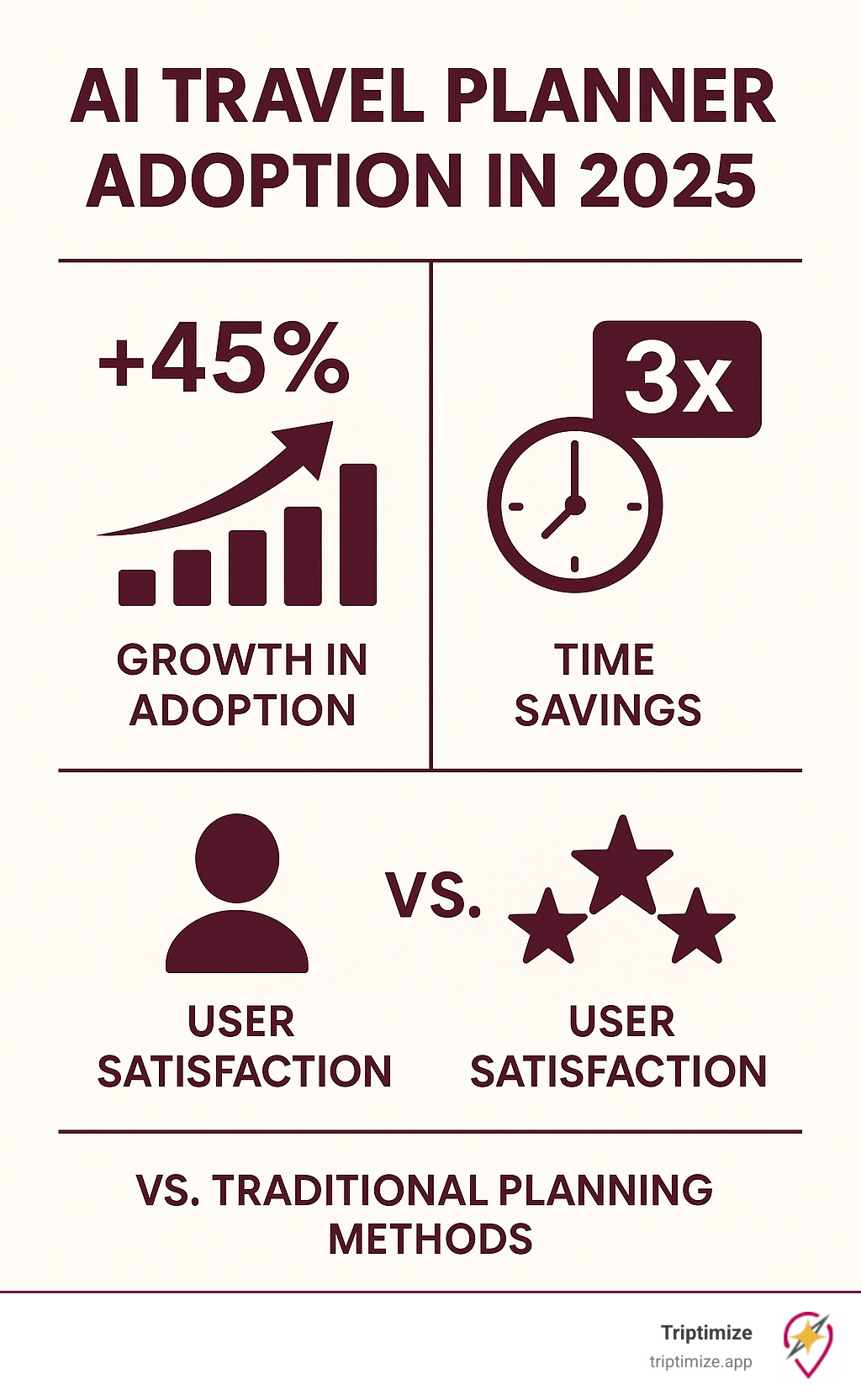
The most immediate benefit is time savings. Instead of spending entire weekends researching destinations across dozens of websites, you can describe your perfect trip and receive a complete itinerary in minutes. One traveler put it perfectly: “This kind of smart technology has made travel planning a breeze.”
But the real magic happens when you realize you’re no longer drowning in decision fatigue. No more agonizing over whether to visit the museum or the park first, or wondering if that restaurant is worth the detour. As one user shared: “I love traveling but hate planning. This app quickly organizes trip agendas, reducing decision fatigue.”
The technology also acts like having a well-traveled friend who knows all the best spots. AI systems analyze patterns from millions of travelers to suggest hidden gems and authentic experiences that perfectly match your interests—places you might never have finded on your own.
Read more insights on our blog
Hyper-Personalization and Customization
Here’s where ai travel planners truly shine: they understand that no two travelers are alike. Gone are the days of generic “top 10” lists that treat every visitor the same way.
The AI learns your unique travel style and preferences. Are you a foodie who dreams of Michelin-starred restaurants, or do you prefer finding authentic street food markets? The system knows the difference and crafts recommendations accordingly.
This personalization touches every aspect of your trip. Celebrating an anniversary? The AI might suggest romantic restaurants with sunset views. Traveling with young children? It automatically factors in family-friendly activities and shorter walking distances between attractions.
The technology can create specialized itineraries for movie and TV show fans, foodies seeking culinary trips, couples planning romantic getaways, and even niche interests you might not expect. This level of customization would take hours of manual research to achieve—if you could even figure out where to start.
Find custom travel experiences
Efficiency and Optimization

Remember trying to plan that multi-city European trip and feeling like you needed a degree in logistics? AI travel planners excel at exactly these complex challenges that make human planners want to give up.
Route optimization is where the technology really shows its power. Advanced systems can crunch millions of options to link flights, trains, and drives into seamless itineraries. This isn’t just about finding the cheapest flights—it’s about creating the most efficient overall journey that maximizes your time and minimizes your stress.
The AI prevents those frustrating moments when you realize you’ve accidentally planned to zigzag across a continent instead of following a logical path. Multi-destination planning becomes manageable when the system handles the complex logistics automatically.
Cost optimization is another game-changer. The AI analyzes pricing patterns, identifies the best deals, and suggests alternatives that fit your budget without sacrificing quality. It can spot opportunities like flights under $100 to beach destinations that you might miss in manual searches.
Whether you’re planning a cross-country road trip with multiple stops or a complex international journey, the efficiency gains are remarkable. What used to require hours of careful coordination now happens automatically.
Learn about multi-destination trip planning
Key Features of a Modern AI Travel Planner
Today’s ai travel planners have evolved into comprehensive travel companions that handle every aspect of your journey. The best systems offer automated itinerary creation that generates complete day-by-day plans with activities, dining, and transportation suggestions.
Booking integration means you can seamlessly connect with flights, hotels, and car rental services without jumping between different platforms. Interactive maps help you visualize your itinerary with custom maps showing all your saved locations, so you can see how everything fits together geographically.
Centralized document organization keeps all your confirmations, tickets, and receipts in one place—no more frantically searching through emails at the airport. Real-time updates notify you about flight delays, weather changes, or local events that might affect your plans.
For group travel, collaborative tools let you share itineraries with travel companions and make group decisions easily. Everyone can see the plan, suggest changes, and stay on the same page throughout the planning process.
These features work together to create what many travelers describe as an “all-in-one travel organizer” that finally eliminates the need for complicated spreadsheets and multiple apps cluttering your phone.
A Practical Guide to Mastering Your AI Planning Assistant
Getting the most out of your ai travel planner isn’t about finding the perfect prompt on your first try. It’s about building a conversation with a system that has access to incredible amounts of travel data but needs your guidance to understand what makes your perfect trip.
Think of it like working with a brilliant travel agent who knows everything about every destination but has never met you before. The more specific you are about your preferences, constraints, and travel style, the better your results will be.
The magic happens through an iterative process. You start with your initial request, see what the AI suggests, and then refine based on what excites you and what doesn’t quite fit. This back-and-forth approach helps you find possibilities you might never have considered while ensuring the final plan truly matches your vision.
Tips for Using Your AI Travel Planner Effectively
Be specific with your requests rather than keeping things vague. Instead of “plan a trip to Europe,” try something like “plan a 10-day cultural trip to Italy and France for two people, budget $4,000, interested in art museums, local cuisine, and avoiding crowded tourist spots.” The AI can work with general requests, but specific details lead to much better results.
Include all your constraints from the start. Your budget, travel dates, group size, mobility requirements, dietary restrictions, and personal preferences all matter. The AI can only optimize for the factors you tell it about, so don’t hold back on the details.
Use natural language when describing your trip. You don’t need formal formatting or travel industry jargon. Describe your ideal vacation the way you’d tell a friend: “We want somewhere warm in March, love good food, and prefer smaller cities to big metropolises.”
Ask for alternatives if the first suggestion doesn’t quite hit the mark. Try requests like “Can you suggest something similar but with more outdoor activities?” or “What would this look like with a $500 higher budget?” The AI can generate multiple variations quickly.
Fact-check critical details before you book anything. While AI is excellent at planning, always verify important information like visa requirements, opening hours, and current prices. AI systems can sometimes provide outdated information or even fabricated facts, so your human judgment remains essential.
Treat it as a collaborative process rather than expecting perfection immediately. Use the initial itinerary as a starting point, then ask the AI to adjust timing, swap activities, or add specific experiences you’re interested in.
Collaborative Planning for Groups and Families
Group travel planning used to mean endless text chains, conflicting preferences, and someone (usually you) stuck managing a massive spreadsheet. AI travel planners transform this chaotic process into something actually manageable.
The technology excels at balancing different interests and constraints within a single itinerary. When planning a family trip, the AI can suggest activities that work for both adults and children, factor in nap times, and even propose backup indoor options in case of bad weather.
For friend groups, the collaborative features become invaluable. Everyone can see the proposed itinerary, suggest changes, and vote on alternatives through a shared interface. This eliminates those painful group discussions where half the people don’t respond and the other half can’t agree on anything.
The centralized communication aspect is particularly helpful for complex trips. Instead of scattered conversations across multiple platforms, everything from itinerary discussions to budget tracking happens in one place. This keeps everyone informed and reduces the mental load on whoever ends up being the default trip organizer.
Explore group trip planning features
Find tools for couples planning
Costs and On-the-Go Adjustments
The cost structure of ai travel planners varies widely, with many offering free basic versions alongside premium subscriptions. Free accounts typically provide limited features or a certain number of uses, while paid plans open up advanced capabilities like real-time updates and unlimited planning.
The real value often emerges during your actual trip. When your flight gets delayed, weather changes your outdoor plans, or you simply fall in love with a city and want to stay longer, AI can instantly suggest alternatives and help you adjust your itinerary on the fly.
Real-time updates during travel represent one of the most practical benefits of premium features. Instead of scrambling to research alternatives when plans change, you can quickly ask your AI assistant to suggest nearby activities or alternative routes that fit your remaining time and budget.
Many systems also offer offline access by allowing you to download your itinerary as a PDF. This ensures you can access your plans even without internet connectivity, which proves invaluable when traveling internationally or in areas with spotty coverage.
The ability to make spontaneous changes during your trip removes much of the stress from travel disruptions. What used to require hours of research and rebooking can now be handled in minutes, letting you focus on enjoying your vacation rather than managing logistics.
Navigating the Pitfalls: What to Watch Out For

Let’s be honest – ai travel planners aren’t magic wands that solve every travel problem. While they’re incredibly powerful tools, they come with their own set of challenges that smart travelers need to understand.
Think of AI as that enthusiastic friend who’s been everywhere and knows everything, but sometimes gets details mixed up or remembers things that never actually happened. The technology is amazing at processing huge amounts of information and creating clever solutions, but it still needs your human wisdom to keep things on track.
The golden rule? Always treat AI suggestions as your starting point, not your final answer. As travel experts consistently advise, you should “always verify the information generated by the AI trip planner” and use it as “initial inspiration” rather than absolute truth.
Data Accuracy and “Hallucinations”
Here’s where things get tricky. Many AI systems are working with information that has expiration dates. Some models use data that only goes “up to mid-2021,” which means they might not know about that amazing new restaurant that opened last year or the museum that closed during the pandemic.
But the bigger problem is something called “hallucinations” – when AI confidently presents information that sounds completely reasonable but is totally made up. Picture this: your AI planner suggests a charming little bistro with perfect reviews, complete with opening hours and a detailed description. You show up hungry, only to find an empty lot where the restaurant supposedly stands.
This isn’t the AI trying to trick you – it’s just how these systems sometimes work. They’re so good at recognizing patterns that they can create believable-sounding information that doesn’t actually exist.
The reality check approach is your best defense. Double-check flight times before you book that taxi to the airport. Look up those restaurant recommendations and read recent reviews. Verify visa requirements through official government sources, not just what the AI tells you. Cross-reference addresses and phone numbers for anything important to your trip.
Lack of Human Nuance
AI is brilliant at crunching numbers and spotting patterns, but it can miss the subtle human elements that make travel truly special. The technology might get “flummoxed when given complex constraints” or completely miss emotional cues that a human travel expert would pick up instantly.
For example, your ai travel planner might suggest a technically perfect restaurant – great reviews, perfect location, fits your budget – but it doesn’t know that you’re trying to avoid chain restaurants because you want authentic local experiences. Or it might recommend a busy market that’s objectively amazing but doesn’t realize you’re looking for quiet, contemplative experiences.
There’s also the risk of becoming too dependent on optimization. While AI excels at logistics, the most memorable travel moments often come from spontaneous findies – that hidden café you stumbled upon, the local festival you didn’t know was happening, or the conversation with a stranger that changed your whole perspective on a place.
Trust your instincts when something feels off about a recommendation. Don’t ignore advice from locals just because it contradicts your AI-generated plan. Be ready to throw your perfectly optimized itinerary out the window when life presents you with something better. After all, the best travel experiences often can’t be algorithmically predicted – they just happen.
The Future of Travel: What’s on the Horizon for AI Planners?
We’re standing at the edge of something remarkable. The ai travel planner tools we use today are impressive, but they’re just the opening act. What’s coming next will transform how we think about travel entirely.
Imagine having an intelligent travel companion that knows you better than you know yourself. It remembers that you loved that tiny café in Prague but hated the crowded museum in Rome. It learns from every trip, every choice, every moment of joy or frustration, building a profile of what makes your perfect trip.
This isn’t science fiction – it’s the natural evolution of travel technology. We’re moving toward what experts call a symbiosis of AI and human expertise, where artificial intelligence handles the heavy lifting while you focus on the experiences that matter most.
The travel industry is already adapting to this shift. Hotels are redesigning their booking systems, airlines are rethinking their route planning, and local experience providers are creating new ways to connect with AI-driven travelers. The revolution in travel planning isn’t just changing how we plan – it’s changing how the entire industry operates.
The Next Wave of Innovation
Hyper-personalization is about to get scary good. Future AI systems won’t just know you prefer beaches over mountains – they’ll understand that you love beaches in the morning but prefer cultural activities in the afternoon. They’ll recognize when you’re feeling adventurous versus when you need a relaxing trip.
Predictive analytics for disruptions will make travel stress a thing of the past. Your AI assistant will know about that storm brewing three days before it hits and automatically suggest alternative plans. It’ll spot patterns in flight delays and reroute you before problems even surface.
The deeper integration with the travel ecosystem means seamless experiences from start to finish. Your AI planner will automatically rebook your canceled flight, adjust your hotel check-in time, and even suggest restaurants near your new arrival gate – all without you lifting a finger.
Augmented reality overlays will bring your itinerary to life. Point your phone at a building and instantly see its history, nearby restaurants, and personalized recommendations based on your interests. Navigation will adapt to your walking speed and suggest photo spots along the way.
Voice-activated planning will make trip adjustments as natural as asking a friend for advice. “Hey, it’s raining – what should we do instead?” Your AI companion will instantly suggest indoor alternatives that match your mood and location.
Impact on the Travel Industry
The rise of AI travel planners is democratizing travel planning in ways we never imagined. A first-time visitor to Tokyo can now create an itinerary as sophisticated as someone who’s been there dozens of times. Complex multi-city European trips become manageable for anyone with a smartphone.
This technology is driving innovation across the entire travel ecosystem. Airlines are developing new pricing models that work with AI optimization. Hotels are creating packages specifically designed for AI-planned trips. Local tour operators are partnering with AI platforms to reach travelers they never could before.
We’re witnessing a fundamental shift from traditional travel agents to AI assistants for many types of trips. While human expertise remains valuable for complex or highly specialized travel, AI is enhancing traveler satisfaction by making personalized planning accessible to everyone.
The future promises new travel possibilities we haven’t even imagined yet. AI might find connections between destinations that humans never considered, or create themed experiences that perfectly match your personality and interests.
Conclusion
The revolution in travel planning is here, and it’s changing how we approach our trips. AI travel planners have evolved from basic suggestion tools into sophisticated systems that understand your unique travel style, handle complex logistics, and uncover experiences you might never find on your own.
The benefits speak for themselves: dramatic time savings that turn hours of research into minutes of planning, stress reduction that eliminates decision fatigue, and personalized recommendations that go far beyond generic top-10 lists. These systems excel at the tedious parts of planning while leaving you free to dream about your upcoming trip.
But here’s the thing – ai travel planners work best when you understand both their incredible capabilities and their limitations. They’re powerful allies that still need your human insight, critical thinking, and the wisdom to know when your gut feeling trumps algorithmic suggestions.
At Triptimize, we’ve designed our ai travel planner to harness all these benefits while addressing the common pitfalls that frustrate travelers. Our system provides real-time updates when your plans inevitably change, eliminates the spreadsheet juggling that drives people crazy, and creates fully optimized itineraries that work whether you’re traveling solo or coordinating a group trip.
The future of travel planning is here, and it’s personalized, efficient, and intelligent. Instead of spending your precious vacation time buried in research tabs and comparison sites, you can focus on what actually matters – creating those unforgettable memories with the people you care about.
Your next trip is waiting, and the planning doesn’t have to be a chore anymore. The technology is proven, it’s accessible, and it’s ready to transform how you experience travel.
Are you ready to plan your next trip in minutes instead of hours?